

Alisa Dean writes romance primarily at her favorite local coffee shop, hopeful that anyone sneaking a peek at her steamy screen will be intrigued and even liberated by stories of love, desire, self-discovery, and partnership. As a university professor, Alisa also writes less-liberating academic articles about how writing works in the world, and she will likely encourage her students to analyze this very bio for its patterns. Alisa favors long walks among very tall trees with her characters for company.
Represented by Christina Miller @ Nancy Yost Literary Agency

Enjoyment Without Shame: PW Talks with Alisa Dean
Publishers Weekly, vol. 273, issue 25 (June 22, 2026)
"A lot of why I became so obsessed with romance novels is because of my journey of healing from religious trauma. Romance novels are about being known for exactly who you are and being appreciated for exactly who you are. That's what it was like for me coming out of a shame-based religious upbringing and learning to appreciate who I am. It sounds so silly to call this book a religious trauma rom-com out loud. Like, how does that even work? But the genre actually makes so much sense as a place to unpack these themes."

Alisa Dean on Just Saying It
My Best Writing Tip (August 15, 2026)
"There's so much power in a narrative. Our universes are pretty random and chaotic. We're constantly trying to build narratives out of it, because it's the only way to make meaning. That's why it can be so hard when you're in the middle of something because you can't build a beginning, middle, and end yet. But once you can--once you can look back and build a beginning, middle, and end--we make patterns where there maybe aren't patterns, but to me that's a beautiful thing. That's how we make meaning, that's how we draw out larger truths, that's how we process and appreciate our lives and our experiences. So there is such a power in narratives beyond just base facts."

How to Write a Religious Trauma Rom-Com
The Nerd Daily (August 23, 2026)
"It is easy to think that romances are meant to be happy and hopeful, so they are not the place to engage with the hard and ugly parts of life. However, I believe the exact opposite is true. [...] Falling in love means being seen by another person. All of our damage and flaws are on full display, and yet we are worth loving anyway. Is there anything more hopeful? More comforting? More capable of allowing us to accept and digest our traumatic experiences?"
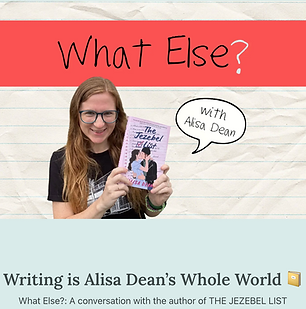
Writing is Alisa Dean's Whole World
What Else? By Rachel A.G. Gilman (September 23, 2026)
"I think I use the word 'cozy' to mean there are a lot of very sweet brunches and literally cozying up on the couch. We get to see them joking around, lying in bed, being sweet and having long conversations, or getting tickled texting each other. I’m obsessed with the everyday. [...] It makes me feel alive. It’s people sharing themselves and being known. This idea of learning one another and slowly trusting one another, what that looks like in everyday. Grand gestures don’t broker trust. The everyday does."